
1.3 Hands-on: PPO Training Visualization
Browse related experiments in the labSection goal: Run the pure PyTorch PPO implementation, save the raw metrics, generate curves from the CSV file, and evaluate the trained policy in CartPole.
Learning path: 1.1 Run CartPole → 1.2 CartPole Principles → 1.3 PPO Training Visualization
Code and resources: training script · plotting script · frame capture script · raw CSV
Use AI when you get stuck
This section runs scripts on your own machine, where environment issues are common. When an install fails, versions conflict, or a run breaks, paste the full error into an AI coding assistant — it is the fastest way to get a diagnosis, a fix, or a runnable command.
The previous sections established the evidence we need: returns must be computed from complete episodes, and the final policy needs an independent evaluation. We now run that full chain.
1.3.1 Install and run
cd code/chapter01_cartpole
pip install -r requirements.txt

python 2-pytorch_ppo.py \
  --seed 42 \
  --iterations 40 \
  --steps-per-rollout 2048 \
  --swanlab-mode disabled \
  --log-csv output/training_metrics_seed42.csv
The run creates two local files:
output/pytorch_ppo_cartpole.pth: trained model parameters;output/training_metrics_seed42.csv: metrics for every iteration.mean_episode_rewardis a rolling mean over the last 100 episodes,mean_episode_reward_rolloutis the mean of episodes that ended in that iteration, and the other columns are unsmoothed.
To use the local SwanLab dashboard, change --swanlab-mode disabled to --swanlab-mode local, then run swanlab watch swanlog.
1.3.2 PPO data flow
Every training iteration has three stages:

1. Collect a rollout
Gymnasium returns both terminated and truncated:
next_obs, reward, terminated, truncated, _ = env.step(action.item())

with torch.no_grad():
    if terminated:
        next_value = 0.0
    else:
        _, next_value_tensor = model(torch.FloatTensor(next_obs))
        next_value = next_value_tensor.item()
terminated=True means the pole fell or the cart left the allowed region, so future return is zero. truncated=True means the 500-step time limit was reached while the state still has value, so the target bootstraps from V(s').
A rollout can end in the middle of an episode. The script carries both the observation and unfinished episode counters into the next rollout. GAE stops at environment resets, while logged episode returns are not cut at training-batch boundaries.
2. Compute GAE
Each step first has a temporal-difference error:
GAE accumulates those errors backward:
episode_end = t["terminated"] or t["truncated"]
delta = t["reward"] + gamma * t["next_value"] - t["value"]
gae = delta + gamma * lam * (1.0 - float(episode_end)) * gae
The multiplier 1 - episode_end stops recursion at every reset. A time-truncated step still uses next_value for its own TD error, but the next episode's advantage cannot propagate backward.
The Critic learns an unnormalized target. Normalization applies only to policy advantages:
returns = raw_advantages + values
advantages = (raw_advantages - raw_advantages.mean()) / (
    raw_advantages.std(unbiased=False) + 1e-8
)
3. Apply the PPO clipped update
The probability ratio for each sampled action is:
The script uses clip_eps=0.2:
ratio = torch.exp(new_log_probs - batch_old_log_probs)
surr1 = ratio * batch_advantages
surr2 = torch.clamp(ratio, 0.8, 1.2) * batch_advantages
policy_loss = -torch.min(surr1, surr2).mean()
1.3.3 Plot from the raw CSV
The training script exports CSV directly. The plotting script reads only that file, so every point maps to one raw record.
python plot_curves.py \
  --input output/training_metrics_seed42.csv \
  --output-dir output
The course page shows the result generated on 2026-08-13 with seed 42:
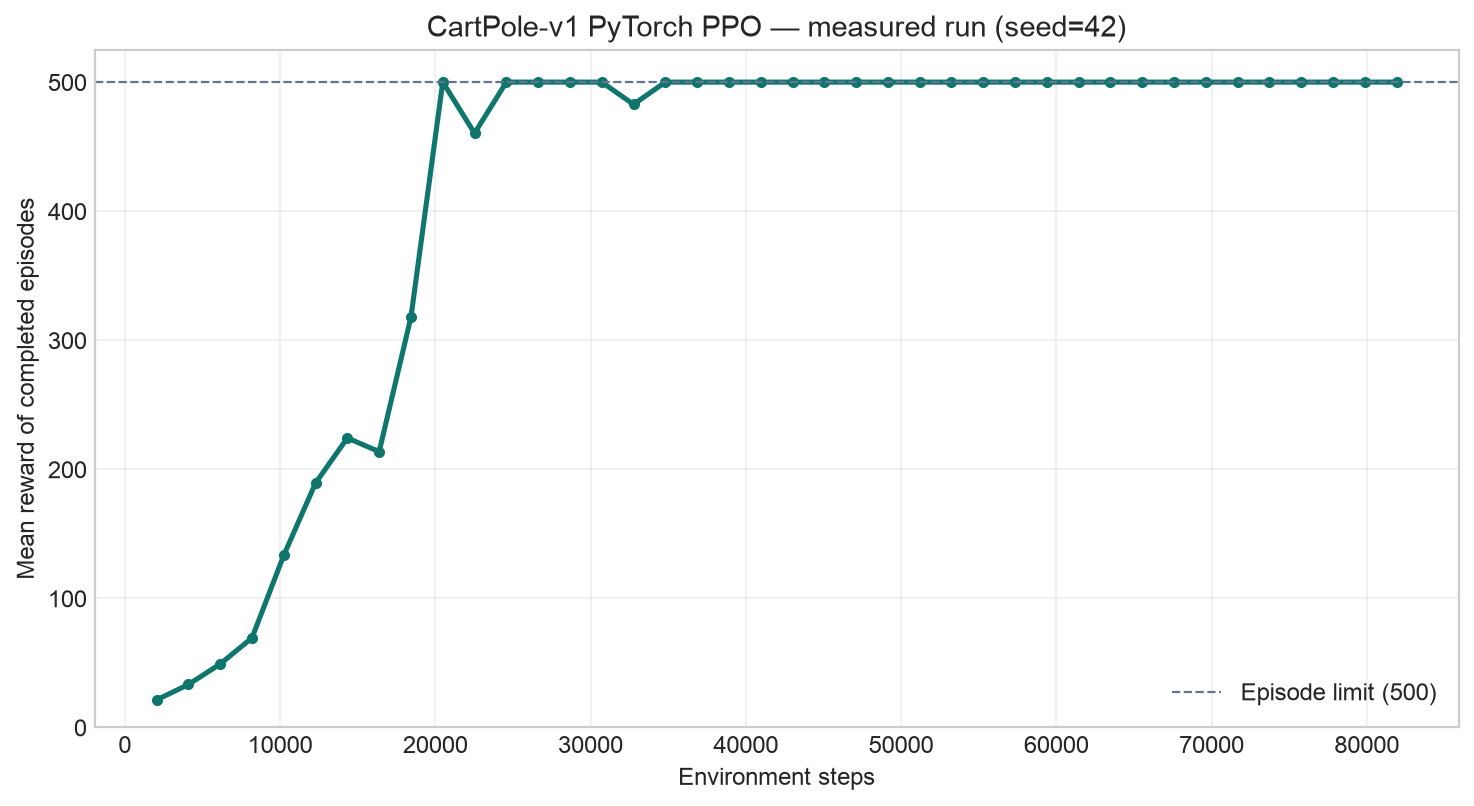
The first rollout averaged 21.35; the four complete episodes in iteration 10 averaged 500.0. Iteration 11 dropped to 460.4, so the single-run curve is not monotonic. The final deterministic 20-episode evaluation was 500.0 ± 0.0.
This single-seed curve verifies that the implementation can solve the task. It is not a multi-seed algorithm comparison.
1.3.4 Capture frames from the real environment
capture_frames.py loads the saved model, runs deterministic evaluation in Gymnasium CartPole-v1, and records frames returned by env.render(). The image is not a hand-drawn illustration.
python capture_frames.py \
  --model output/pytorch_ppo_cartpole.pth \
  --output output/cartpole_frames_seed42.png \
  --seed 10042
A still frame proves only one moment. The complete episode score, frames at multiple times, and independent evaluation statistics jointly support the result.
1.3.5 Reporting parameter changes
Learning rate, clipping, and GAE settings change the curve, but one seed cannot establish a general result. A comparison should hold environment version, training budget, network, and evaluation protocol constant, then run multiple seeds.
Useful questions are testable:
- Does
lr=1e-4require more environment steps than3e-4to reach the same evaluation score? - Does
clip_eps=0.1reduce KL while slowing return improvement? - Across several seeds, how often does incorrectly propagating GAE across episodes make the final evaluation fail?
Report raw curves for every seed, the environment steps needed to reach the chosen target, and final evaluation scores. Do not present one attractive curve as an algorithmic guarantee.
Section Summary
A complete experiment fixes the seed, saves raw metrics, plots from those metrics, evaluates independently, and captures rendered frames from the real environment. If one part cannot be traced, its numbers or images should not be described as measured results.