
23.3 Hands-on: Multimodal GRPO
Section goal: Implement a minimal multimodal GRPO loop for shape-counting questions and use rule-based rewards to study answer accuracy.
Learning path: 15.1 GRPO → 23.1 Visual Reward Design → 23.2 Reflection RL for Vision → 23.3 Multimodal GRPO → 23.4 GeoQA
Code and resources: vlm_grpo_train.py
The repository script is a teaching simulation of the multimodal GRPO data flow. It uses templates to produce responses of different quality; it does not download or update a real vision-language model.
Run it from the repository root:
cd code/chapter11_vlm_rl
pip install -r requirements.txt
python vlm_grpo_train.py
The output checks grouped rewards, relative advantages, and a simulated learning curve. It cannot establish that a real vision-language model learned to count.
Chapter 15 applied GRPO to text-only mathematical reasoning. Here the input includes an image and a question, while the reward still compares multiple responses within each prompt group.
The core difference in this experiment is the input: pure-text GRPO input is a sequence of tokens, while VLM GRPO input is visual tokens (image encoding) + text tokens (question). The reward function and optimization algorithm itself have not changed -- GRPO's core code is exactly the same, except the model input now has an additional image dimension.
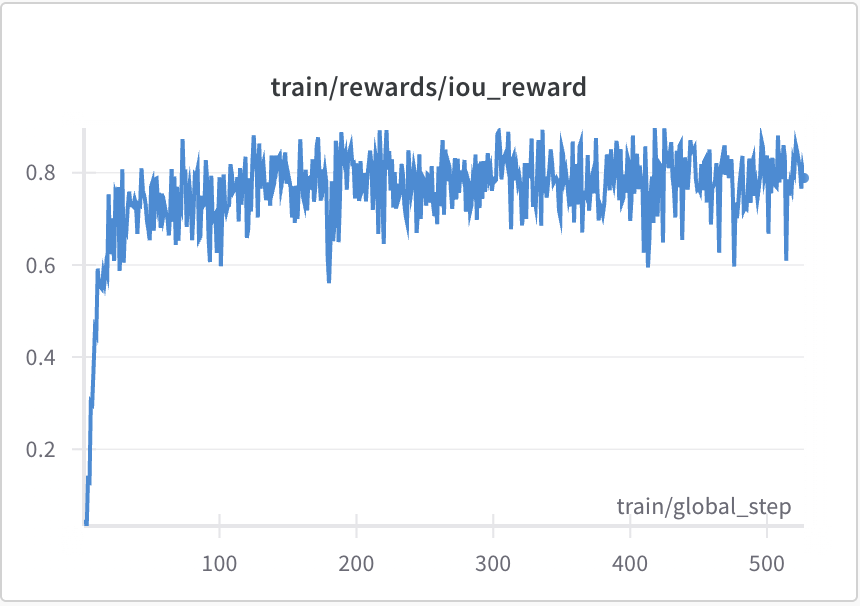
The value of this figure is not in how pretty the curve looks, but in reminding us that VLM RL is not simply "adding a few tokens to an image." As long as the reward can capture visual grounding quality, GRPO can turn "looking at the right places" into an optimizable training signal. The geometric shape counting experiment below is the minimal version of this idea.
23.3.1 Dataset: Geometric Shape Counting
We chose a simple visual question-answering task: geometric shape counting. The advantage of this task is that it has objectively correct answers that can be evaluated with rule rewards, requiring no additional RM training.
Each image contains several basic geometric shapes (triangles, circles, squares). Questions are of the form "How many circles are in the image?" The model's ideal response process is: first describe what it sees ("I see 3 triangles, 2 circles, and 1 square in the image"), then reason to the answer ("So the number of circles is 2").
# ==========================================
# Dataset: Geometric shape counting
# ==========================================
from datasets import Dataset
import random

def generate_shape_image(num_triangles, num_circles, num_squares, seed=None):
    """Generate an image containing a specified number of geometric shapes."""
    from PIL import Image, ImageDraw

    if seed is not None:
        random.seed(seed)

    img = Image.new('RGB', (256, 256), 'white')
    draw = ImageDraw.Draw(img)

    # Randomly place triangles
    for _ in range(num_triangles):
        x, y = random.randint(20, 236), random.randint(20, 236)
        size = random.randint(15, 35)
        draw.polygon([(x, y - size), (x - size, y + size), (x + size, y + size)],
                     fill='red', outline='darkred')

    # Randomly place circles
    for _ in range(num_circles):
        x, y = random.randint(20, 236), random.randint(20, 236)
        r = random.randint(10, 25)
        draw.ellipse([(x - r, y - r), (x + r, y + r)],
                     fill='blue', outline='darkblue')

    # Randomly place squares
    for _ in range(num_squares):
        x, y = random.randint(20, 236), random.randint(20, 236)
        s = random.randint(12, 28)
        draw.rectangle([(x - s, y - s), (x + s, y + s)],
                       fill='green', outline='darkgreen')

    return img


def generate_dataset(num_samples=500):
    """Generate a geometric shape counting dataset."""
    data = []
    for i in range(num_samples):
        # Randomly generate 1-5 of each shape
        n_tri = random.randint(1, 5)
        n_cir = random.randint(1, 5)
        n_sqr = random.randint(1, 5)

        img = generate_shape_image(n_tri, n_cir, n_sqr, seed=i)

        # Randomly choose a question
        questions = [
            f"How many triangles are in the image?",
            f"How many circles are in the image?",
            f"How many squares are in the image?",
        ]
        answers = [str(n_tri), str(n_cir), str(n_sqr)]
        q_idx = random.randint(0, 2)

        data.append({
            'image': img,
            'question': questions[q_idx],
            'answer': answers[q_idx],
            'ground_truth': {
                'triangles': n_tri,
                'circles': n_cir,
                'squares': n_sqr,
            }
        })

    return Dataset.from_list(data)

# Generate training and validation sets
train_dataset = generate_dataset(500)
val_dataset = generate_dataset(100)
23.3.2 Reward Design: Three-Dimensional Evaluation
The reward function for this task has three dimensions, each with clear scoring criteria:
| Reward dimension | Score | Evaluation criteria | Type |
|---|---|---|---|
| Correctness | +1.0 | Final answer matches ground truth | Rule reward |
| Reasoning quality | +0.5 | Response includes description of image content | Rule reward |
| Format compliance | +0.2 | Response follows "describe -> reason -> answer" format | Rule reward |
The thinking behind this reward design: correct answers are most important (+1.0), but we do not just want a model that "guesses correctly" -- we want a complete "look at image -> describe -> reason -> answer" chain. So reasoning quality (+0.5) and format compliance (+0.2) serve as auxiliary rewards, guiding the model to form correct reasoning habits.
# ==========================================
# Reward function: Three-dimensional evaluation
# ==========================================
import re

def compute_reward(response, ground_truth, target_shape):
    """
    Compute three-dimensional reward score.
    - response: model-generated answer
    - ground_truth: {'triangles': n, 'circles': n, 'squares': n}
    - target_shape: target shape for this question ('triangles'/'circles'/'squares')
    """
    reward = 0.0

    # 1. Correctness reward: extract final answer, check if correct
    correct_answer = str(ground_truth[target_shape])
    # Try to extract number from end of response
    numbers = re.findall(r'\d+', response)
    if numbers and numbers[-1] == correct_answer:
        reward += 1.0

    # 2. Reasoning quality reward: check if image content is described
    shape_keywords = {
        'triangles': ['triangle', 'red', 'triangular'],
        'circles': ['circle', 'blue', 'circular'],
        'squares': ['square', 'green', 'rectangular'],
    }
    has_description = any(kw in response.lower() for kw in shape_keywords[target_shape])
    if has_description:
        reward += 0.5

    # 3. Format compliance reward: check if reasoning keywords are included
    reasoning_keywords = ['therefore', 'so', 'total', 'the count is', 'the answer is']
    has_reasoning = any(kw in response.lower() for kw in reasoning_keywords)
    if has_reasoning:
        reward += 0.2

    return reward
23.3.3 Before-and-After Training Comparison
Before training, a model may output only a count, with no visual description that can be inspected. The intended behavior after training is to describe the relevant shapes before giving the final count. The loop below shows how format, description, and answer rewards can encourage that structure.
# ==========================================
# VLM GRPO training loop
# ==========================================
def vlm_grpo_train(model, tokenizer, dataset, num_epochs=3, group_size=4, lr=1e-6):
    """
    Train VLM with GRPO.
    - group_size: how many responses to generate per prompt (for within-group comparison)
    """
    optimizer = torch.optim.AdamW(model.parameters(), lr=lr)
    normalizer = RewardNormalizer()

    for epoch in range(num_epochs):
        for batch in DataLoader(dataset, batch_size=8):
            all_log_probs = []
            all_rewards = []

            for prompt_img, prompt_text, ground_truth, target_shape in batch:
                # Generate group_size responses per prompt
                group_responses = []
                group_log_probs = []
                group_rewards = []

                for _ in range(group_size):
                    # VLM forward pass: input image + text
                    response, log_prob = model.generate_with_log_prob(
                        image=prompt_img,
                        text=prompt_text,
                        max_new_tokens=128,
                        temperature=0.8
                    )

                    # Compute reward
                    reward = compute_reward(response, ground_truth, target_shape)

                    group_responses.append(response)
                    group_log_probs.append(log_prob)
                    group_rewards.append(reward)

                all_log_probs.append(group_log_probs)
                all_rewards.append(group_rewards)

            # GRPO core: compute group-relative advantages
            # Recall Chapter 16: group-relative advantage = (R_i - mean) / std
            rewards_tensor = torch.tensor(all_rewards)
            mean_r = rewards_tensor.mean(dim=-1, keepdim=True)
            std_r = rewards_tensor.std(dim=-1, keepdim=True) + 1e-8
            advantages = (rewards_tensor - mean_r) / std_r

            # Policy gradient loss
            log_probs_tensor = torch.stack([torch.stack(lp) for lp in all_log_probs])
            loss = -(log_probs_tensor * advantages.detach()).mean()

            # Add KL penalty (recall Chapter 8)
            kl_penalty = compute_kl_penalty(model, ref_model, batch)
            loss = loss + 0.05 * kl_penalty

            optimizer.zero_grad()
            loss.backward()
            torch.nn.utils.clip_grad_norm_(model.parameters(), max_norm=1.0)
            optimizer.step()
The following pair illustrates the evaluation target. It is an expected behavior change, not stored output from a real training run. Before training, the model might answer:
Before training: “3.”
The intended response after training is:
After training: “The image contains two red triangles, three blue circles, and one green square. The question asks for circles, so the answer is 3.”
If this structure appears consistently after training, the format and description rewards are having the intended effect. Accuracy must still be measured on a separate validation set.
23.3.4 Training Metric Analysis
When training a VLM, in addition to the standard metrics mentioned in Chapter 13 (reward, KL divergence, response length), there are several multimodal-specific metrics worth monitoring:
Attention heatmaps. An attention map can reveal whether text positions assign weight to image regions. It can help detect a model that ignores the image, but it cannot by itself prove correct counting. Held-out answer accuracy remains the main task metric.
Relationship between reasoning length and accuracy. Track the relationship between the length of the reasoning portion in responses and final answer accuracy. The ideal pattern is an inverted U-curve -- moderate reasoning length works best. Too short means the model did not carefully examine the image (guessing answers); too long may mean the model is "overthinking" or even producing visual hallucinations.
Cross-generalization testing. Test the model's performance on new shape combinations outside the training set. If the model has truly learned the "look and count" capability, it should answer correctly on never-before-seen shape combinations -- for example, training used at most 5 shapes per type, but testing with 7.
Exercise: Why is the learning rate for VLM GRPO (1e-6) in a narrower range than for pure-text GRPO (typically 5e-7 to 1e-5)?
VLM contains two components -- a vision encoder (ViT) and a text decoder (Transformer). If the learning rate is too large, RL gradients may destroy the features the vision encoder has already learned (image understanding ability), causing the model to "go blind" -- it still outputs text but can no longer "understand" images. If the learning rate is too small, the text decoder's policy updates are too slow, making training extremely inefficient.
In practice, a common approach is to use different learning rates for the vision encoder and text decoder -- the vision encoder gets a smaller learning rate (e.g., 1/10 of the text decoder's), or the vision encoder is completely frozen. This preserves visual understanding ability while allowing the text generation component to fully optimize through RL. The next section will discuss this strategy choice in detail.
This experiment is simple, but it demonstrates the core VLM RL workflow: the algorithm is exactly the same as pure-text RL (GRPO), but the input now includes images, and reward evaluation needs to account for visual understanding dimensions. Next, we will dive deeper into what new challenges arise when input goes from pure text to "image + text" that simply do not exist in pure-text scenarios -- Special Challenges in VLM RL.
References
- VLM-R1 GitHub -- Provides VLM-R1 training curves, grounding reward examples, and open-source implementation; can serve as a real-world reference for the experiment in this section.
Section Summary
- The repository script demonstrates grouped rewards and relative advantages with simulated responses.
- A real VLM experiment must load a multimodal model, update its parameters, and evaluate held-out images.
- Format and description rewards are auxiliary signals; final correctness must be measured separately.