
24.2 From Audio Rewards to Real-Time Agents: A Minimal Training Loop
24.1 separated audio rewards into content, prosody, and real-time behavior. Knowing what to reward still does not explain how that reward changes the model. A trainer must sample several responses to the same audio, send text and synthesized speech to different evaluators, and propagate one response-level score back to generated tokens. If any interface is wired incorrectly, the signal updates a behavior other than the intended one.
This section follows one sample through audio encoding, grouped sampling, speech synthesis, reward calculation, within-group comparison, and policy update. The code explains the data flow rather than replacing an industrial training framework. We then place the single-turn model in a continuing environment and examine interruptions, tool calls, and multi-turn state.

Hands-On: Minimal Audio GRPO Training
Industrial training requires distributed rollout, inference and reward services, and checkpoint management. The minimal workflow below keeps only the interface between reward design and policy updates.
Experimental Setup
# requirements: torch, transformers, librosa, soundfile
import torch
import torch.nn as nn
import torch.nn.functional as F

class AudioDialogueConfig:
    # Audio encoder (pseudo-code: actual use Qwen2-Audio encoder)
    audio_encoder_dim = 1280
    audio_frame_rate = 12.5  # Hz, after downsampling
    # LLM decoder (actual use Qwen2.5-32B, simplified here)
    llm_hidden = 4096
    vocab_size = 152000
    # RL configuration
    group_size = 16         # GRPO samples per group
    max_response_len = 1024
    clip_eps = 0.2          # PPO clip
    beta_kl = 0.0           # Step-Audio sets to 0, allowing free exploration
Two values deserve attention. group_size = 16 is the number of responses sampled per question in Step-Audio-R1's published PPO setting. The paper also sets beta_kl = 0, omitting a reference-model KL penalty during RL. This expands exploration but increases the risk of drifting away from the initialized policy, so it should not be copied to a new task without an ablation.
Model Structure
class AudioDialoguePolicy(nn.Module):
    """Audio understanding policy: audio encoding → LLM reasoning → text response"""
    def __init__(self, config):
        super().__init__()
        # Audio encoder (frozen)
        self.audio_encoder = AudioEncoder(config.audio_encoder_dim)
        for p in self.audio_encoder.parameters():
            p.requires_grad = False
        # Adaptor: 25 Hz → 12.5 Hz
        self.adaptor = nn.Conv1d(config.audio_encoder_dim, config.llm_hidden,
                                  kernel_size=2, stride=2)
        # LLM decoder
        self.llm = TransformerDecoder(config.llm_hidden, config.vocab_size)

    def forward(self, audio, question, response_tokens):
        # 1. Encode audio
        audio_feat = self.audio_encoder(audio)         # (B, T, D)
        audio_feat = self.adaptor(audio_feat.transpose(1,2)).transpose(1,2)

        # 2. Concatenate [audio, question, response] sequences
        inputs = concat_modalities(audio_feat, question, response_tokens)

        # 3. Autoregressively predict response logits
        logits = self.llm(inputs)
        return logits
Reward Function
Implement the three types of rewards described in Section 24.1:
class AudioReward:
    def __init__(self, grm_model, prosody_ref_dist):
        self.grm = grm_model                # Generative Reward Model
        self.prosody_ref = prosody_ref_dist # Human Prosody Distribution

    def content_reward(self, response_text, ground_truth):
        """Content Accuracy"""
        # Use LLM-as-judge to assess semantic equivalence
        prompt = f"Judge whether the answer is equivalent: \nReference: {ground_truth}\nAnswer: {response_text}\nReturn 1 if equivalent, else 0"
        return float(self.grm(prompt))

    def prosody_reward(self, response_audio):
        """Prosody Naturalness"""
        f0 = extract_valid_f0(response_audio)     # Remove unvoiced frames
        f0_var = np.std(f0)
        # Wasserstein distance to human distribution
        f0_w = wasserstein_distance(
            np.histogram(f0, bins=50)[0] / len(f0),
            self.prosody_ref['f0_hist']
        )
        # Penalize flatness (a common failure mode in RLVR)
        flat_penalty = -max(0, 0.3 - f0_var)
        return -f0_w + 0.5 * flat_penalty

    def format_reward(self, response_text):
        """Check the <think>...</think> structure used by MGRD"""
        has_think = '<think>' in response_text and '</think>' in response_text
        return 1.0 if has_think else 0.0

    def total(self, response_text, response_audio, ground_truth, weights=(0.7, 0.2, 0.1)):
        w_c, w_p, w_f = weights
        return (w_c * self.content_reward(response_text, ground_truth)
              + w_p * self.prosody_reward(response_audio)
              + w_f * self.format_reward(response_text))
The Role of Format Reward
The Step-Audio-R1 paper found that removing the format reward () reduced the number of reasoning tokens from 2,800 to 1,500 and lowered the MMAU score by 1.2 percentage points. The optimizer had learned a shorter strategy: answer immediately and omit the <think>...</think> segment.
In the paper's experiment, the format term has weight 0.2 and raises MMAU from 76.5 to 77.7 while restoring late-stage reasoning length to roughly 2,300–2,800 tokens. This result belongs to that model and dataset; a new task still needs its own weight ablation. The format reward proves only that a reasoning segment exists. Whether it uses the correct acoustic evidence depends on MGRD's data filtering and grounding checks.
GRPO Training Loop
We use GRPO (Group Relative Policy Optimization) for training—no critic is needed, making it more suitable for large models:
def grpo_train_step(policy, reward_fn, speech_synthesizer, batch, config):
    """One illustrative GRPO update"""
    token_losses = []

    for prompt, audio, ground_truth in batch:
        # 1. Sample G responses and retain rollout-time log probabilities
        responses = []
        for _ in range(config.group_size):
            with torch.no_grad():
                resp = policy.sample(audio, prompt, config.max_response_len)
                resp.log_prob_old = policy.log_prob(audio, prompt, resp.tokens)
            # Step-Audio-R1 itself outputs text. A separate synthesizer is
            # attached here only to demonstrate a prosody-reward branch.
            resp.audio = speech_synthesizer(resp.text)
            resp.reward = reward_fn.total(resp.text, resp.audio, ground_truth)
            responses.append(resp)

        # 2. Normalize rewards within the prompt group
        rewards = torch.tensor([r.reward for r in responses])
        advantages = (rewards - rewards.mean()) / (rewards.std() + 1e-8)

        # 3. Apply a token-level clipped policy objective
        for resp, advantage in zip(responses, advantages):
            logp_new = policy.log_prob(audio, prompt, resp.tokens)
            ratio = torch.exp(logp_new - resp.log_prob_old)
            clipped = torch.clamp(ratio, 1 - config.clip_eps, 1 + config.clip_eps)
            token_loss = -torch.min(ratio * advantage, clipped * advantage).mean()
            token_losses.append(token_loss)

    return torch.stack(token_losses).mean()

# Main loop
for epoch in range(num_epochs):
    for batch in dataloader:
        optimizer.zero_grad()
        loss = grpo_train_step(
            policy, reward_fn, speech_synthesizer, batch, config
        )
        loss.backward()
        torch.nn.utils.clip_grad_norm_(policy.parameters(), max_norm=1.0)
        optimizer.step()
Why the pseudocode uses GRPO while the paper says PPO
Step-Audio-R1 explicitly reports on-policy PPO: it samples 16 responses per question, uses a clipping coefficient of 0.2, and places reward on the final token. The paper does not call this GRPO and does not disclose replacing a value model with the group mean.
The pseudocode uses GRPO to connect with the course's earlier treatment of group-relative advantages and to show how several responses to one audio input can be compared without a separate critic. A reproduction must follow the paper and official code. Multi-sample PPO and GRPO are not interchangeable names.
Self-Cognition Correction
There's a non-mainstream but critical issue in industrial audio RL: the model forgets it is an audio model. Pretraining data is mostly text-based, so models often respond with "I can't hear anything" or "I am a text model." The self-cognition correction process for Step-Audio-R1:
def self_cognition_correction(policy):
    """Two-stage correction for self-cognition errors"""
    # Stage 1: Iterative self-distillation + LLM judge filtering
    for t in range(T):
        responses = policy.sample(audio_perception_queries)
        # Judge only retains responses with correct self-cognition
        correct = [r for r in responses if judge_acknowledges_audio(r)]
        policy.sft(correct)

    # Stage 2: DPO fine-tuning
    # 8000 preference pairs: correct cognition (w) vs. incorrect cognition (l)
    pref_pairs = build_preference_pairs(correct_cog=positive, text_only=negative)
    policy.dpo(pref_pairs, beta=0.1)
The paper reports a self-cognition error rate of 6.76% for the base model, 2.63% after iterative self-distillation, and 0.02% after DPO. These numbers measure one dedicated self-cognition test set, not general audio accuracy. The correction matters in deployment because an otherwise capable audio model can still destroy the interaction by insisting that it cannot hear.
Forms of Audio Agents
An audio model that answers questions is only the starting point. In a continuing environment it must maintain state across turns and decide when to listen, speak, stop, or call a tool. Three forms are common.
Full-duplex dialogue agents. A traditional assistant alternates turns. A full-duplex agent listens while speaking, can be interrupted, and must sometimes remain silent.
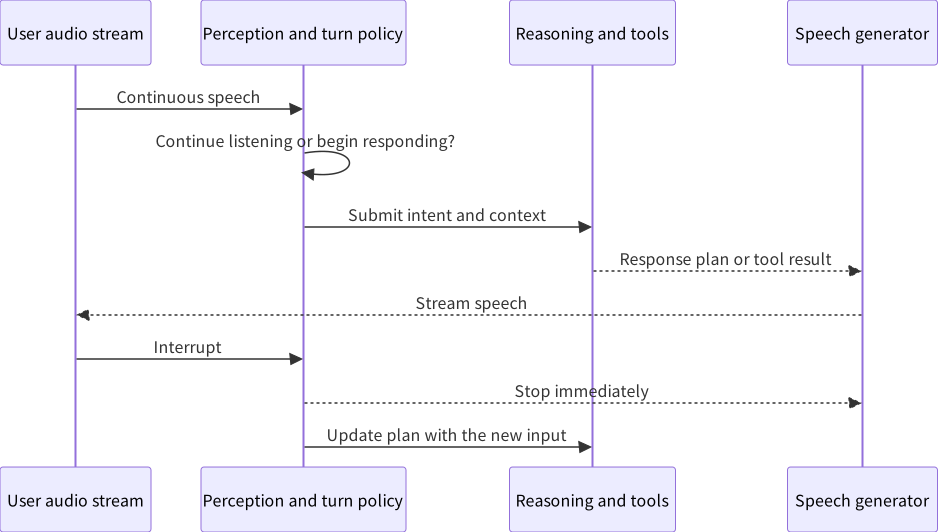
The difficult RL decisions are temporal: when to take the floor, when to yield it, and how to recover context after an interruption. These behaviors lack simple verifiable labels and usually require preference or trajectory-level rewards.
Audio as an agent's perception channel. Here audio supplies perception and output, while planning and tool use remain in text space. A meeting agent combines streaming ASR, speaker separation, summaries, and action-item extraction. Voice search and translation convert speech into tool calls and have verifiable retrieval or translation outcomes. A customer-service agent uses detected emotion to choose a response path, while escalation timing becomes a sequential decision. These systems connect directly to multi-agent collaboration: the audio model perceives and expresses, a text agent plans and invokes tools, and the reward evaluates the whole trajectory.
Audio as an output tool. The core agent reasons in text and invokes speech as an output interface. RL must keep presentation consistent with the decision: serious content should not use a playful tone, and an urgent reminder may require slower, clearer delivery. Today this consistency is mainly supervised by rubric-based preferences; mature verifiable rewards remain limited.
Future Directions
Audio-native reasoning. MGRD grounds a textual chain of thought in acoustic evidence, but the chain is still written in text. A future system could reason directly over prosody and timbre representations. Its reward would also have to move from text-verifiable to acoustically verifiable evidence.
Streaming RL. Step-Audio training primarily rewards complete responses, while real conversations contain interruptions, revisions, and follow-up questions inside a turn. Sentence- or chunk-level feedback is needed to train when to begin and stop speaking.
Long-horizon credit assignment. A poor tone in one turn may cause the user to leave five turns later. This is the same credit-assignment problem seen in agent RL, now with longer delays, acoustic observations, and sparser signals.
Connections to Earlier Chapters
The illustrative training loop uses GRPO group normalization, while the Step-Audio-R1 paper itself reports PPO. The <think> format reward preserves the reasoning chain. Freezing the audio encoder mirrors differentiated VLM updates: RL changes the language policy without rewriting perceptual features. Meeting and service agents use trajectory-level rewards, and DPO preference pairs correct self-cognition and can support prosody alignment.
Question: Why is “when to speak” difficult to train with a verifiable reward?
The correct timing depends on the other person's live state: whether the user is hesitating, about to interrupt, or changing emotion. There is no discrete ground-truth label comparable to answer correctness. Available signals, such as whether the conversation continues or receives a high satisfaction score, are delayed and noisy. Timing therefore requires preference or trajectory-level feedback. This is the temporal extension of the verifiable-reward trap: once the easy-to-check part is optimized, the remaining part is central to the experience.
Summary
The audio-GRPO teaching loop shares the basic structure of text GRPO, but reward evaluation adds speech synthesis and prosody branches. Format rewards and self-cognition correction address two deployment-critical behaviors that answer correctness does not cover. Full-duplex dialogue, audio perception for tool-using agents, and audio as an output tool lead respectively to timing, trajectory-reward, and presentation-consistency problems. Open directions are audio-native reasoning, streaming RL, and long-horizon credit assignment.
The next section, 24.3 VLA Models, connects multimodal perception to physical action under continuous control, real-world costs, and physical constraints.
References
- Step-Audio-R1 Technical Report (arXiv:2511.15848): training configuration and self-cognition correction
- Step-Audio-R1 GitHub: open inference code and model weights
- DeepSeek-R1 (arXiv:2501.12948): the RLVR and GRPO training line that informed Step-Audio-R1
- Moshi (arXiv:2410.00037): full-duplex real-time dialogue and the Mimi codec
- GPT-4o System Card (arXiv:2410.21276): an industrial real-time speech-interaction reference