
20.1 Foundations of SWE-RL
+This section studies one concrete problem: how to place a language model inside a real repository, have it understand an issue, edit code, run tests, and continue repairing from test failures.
- +Ordinary code generation may require only one function. Real software engineering adds long call chains, regressions caused by a local edit, and repeated diagnosis after tests fail. A final patch alone cannot teach the model how to search files, use error messages, or choose the next action. SWE-RL treats the entire repair process as a trainable trajectory and obtains feedback from executable tests.
- +## Start with a Small Task That Really Fails
- +Suppose a shopping-cart project contains:
- +```python +def average_price(prices):
- return sum(prices) / len(prices) +```
- +An issue says that
average_price([])should return0.0without changing nonempty-cart behavior. The repository initially tests only: - +```python +def test_average_price():
- assert average_price([10.0, 20.0]) == 15.0 +```
- +The model's first patch may be too broad:
- +```python +def average_price(prices):
- try:
return sum(prices) / len(prices)- except Exception:
+```return 0.0- +The empty-list test passes, but every exception is now hidden. Passing
Noneincorrectly returns0.0. A regression test exposes the problem: - +```python +def test_invalid_input_is_not_hidden():
- with pytest.raises(TypeError):
+```average_price(None)- +After reading the failure, the model narrows its second patch:
- +```python +def average_price(prices):
- if len(prices) == 0:
return 0.0- return sum(prices) / len(prices) +```
- +One repair has now completed a loop:
- +1. Read the issue and identify behavior that must remain unchanged. +2. Search for and open the relevant files. +3. Generate a candidate patch. +4. Run tests and observe failures. +5. Edit again from the feedback and submit the patch.
- +These five steps form a trajectory. If the repository state at step is and the action is reading, searching, editing, or testing, then
- +
- +Each later observation depends on earlier actions. Opening the wrong file deprives the patch of key context; a failed test can supply the clue needed for the next edit. Reinforcement learning improves this decision trajectory from repository inspection to patch submission.
- +

- +The verifier is usually a test suite executed in an isolated environment. A passing patch earns reward, while failure logs return as the agent's next observation. The agent can therefore revise within one task and update its policy across many tasks.
SWE-bench Task Definition
SWE-bench (Jimenez et al. 2023) is the core benchmark of SWE-RL. Its task definition is as follows:
Input:
  - A GitHub repository (containing the full code)
  - An Issue description (in natural language, describing a bug or a feature request)
  - Test cases (used to verify whether the fix is correct)

Output:
  - A code patch (the modified code)

Validation:
  - Apply the patch to the repository
  - Run the test cases
  - All pass → Task is successful
  - Any test fails → Task is failed
A Concrete Example
Repository: django/django (Django Web Framework)

Issue:
  "In Django 4.2, using `Model.objects.filter(field__in=[])`
   returns an empty queryset, but the SQL query is still executed.
   It should short-circuit to return an empty result, avoiding unnecessary database calls."

Test cases:
  def test_empty_in_lookup_short_circuits(self):
      # Expected: filter(field__in=[]) does not trigger SQL
      with self.assertNumQueries(0):
          list(Model.objects.filter(field__in=[]))

Model Output:
  - Modify django/db/models/sql/query.py
  - Add in the as_sql method: if not self.bloom_metadata and not value: return '', []

Validation:
  - Apply the patch
  - Run the tests: ✓ Passed
  - Task is successful
Difficulty of SWE-bench
The difficulty of SWE-bench far exceeds that of traditional code generation:
| Dimension | Ordinary Code Generation | SWE-bench |
|---|---|---|
| Context | Single function / short description | Entire repository (10K-1M lines) |
| Output | Complete code snippet | Exact patch (diff) |
| Validation | Manual or testing | Automated test suite |
| Multi-file | Rare | Often requires cross-file modifications |
| Reasoning Depth | 1-10 steps | 10-100+ steps |
The state-of-the-art performance on the SWE-bench Verified (high-quality subset, 500 problems):
- Early 2024: ~12% (OpenAI SWE-agent)
- Mid-2024: ~25% (Cognition Devin)
- Early 2025: ~40% (Open-source SWE-RL series)
- End of 2025: ~53% (NVIDIA and others)
- Early 2026: ~65% (Claude Opus 4.7 + tool calls)
Why SWE is an Ideal Arena for RLVR
Recalling Chapter 15 on RLVR — the core idea of RLVR is to replace RM with rule-based verification. RLVR requires three conditions:
- The task has a clear answer: Right is right, wrong is wrong
- Verification can be automated: No need for human judgment
- There is enough training data: To support large-scale RL
SWE perfectly satisfies these three conditions:
Clear Answer
Code either passes the tests or does not — there is no "partially correct" or "subjective judgment." This is the purest "right or wrong" domain outside of mathematics.
Automated Verification
Testing frameworks like pytest and unittest automatically run tests and output PASS/FAIL. The entire verification process requires no human intervention.
Massive Data
- GitHub has over 400 million repositories
- Each PR is a natural SWE task (issue + patch + tests)
- Internal commit histories of industrial companies are also a vast source of training data
These three conditions make SWE-RL one of the most successful applications of RLVR in industry. Companies like Meta, ByteDance, Cognition, Alibaba, and Tsinghua University have all invested heavily in this direction.
SWE-RL vs. Traditional Code Generation
Traditional code generation (e.g., HumanEval, MBPP) involves the following task:
Input: Function signature + docstring
Output: Complete function implementation
This is a short-context, single-file, no-test-feedback setup. RL performs poorly on such tasks — because the generation space is small, SFT (Supervised Fine-tuning) can already reach SOTA (State-of-the-Art) performance.
In contrast, the task of SWE-RL is:
Input: Full repository + Issue + Test cases
Output: Exact patch
Allowed: Multi-step interaction (read file, edit, run test, edit again)
This is a long-context, multi-file, with-test-feedback setup. RL performs well on such tasks — because:
- Exploration space is huge: The number of possible patches is astronomical, and RL can efficiently explore this space
- Delayed feedback: Test results are delayed rewards, which naturally aligns with RL's advantage in reward estimation
- Multi-step decision making: Read → think → edit → test → fix → submit is a typical agent trajectory
Data Generation for SWE-bench
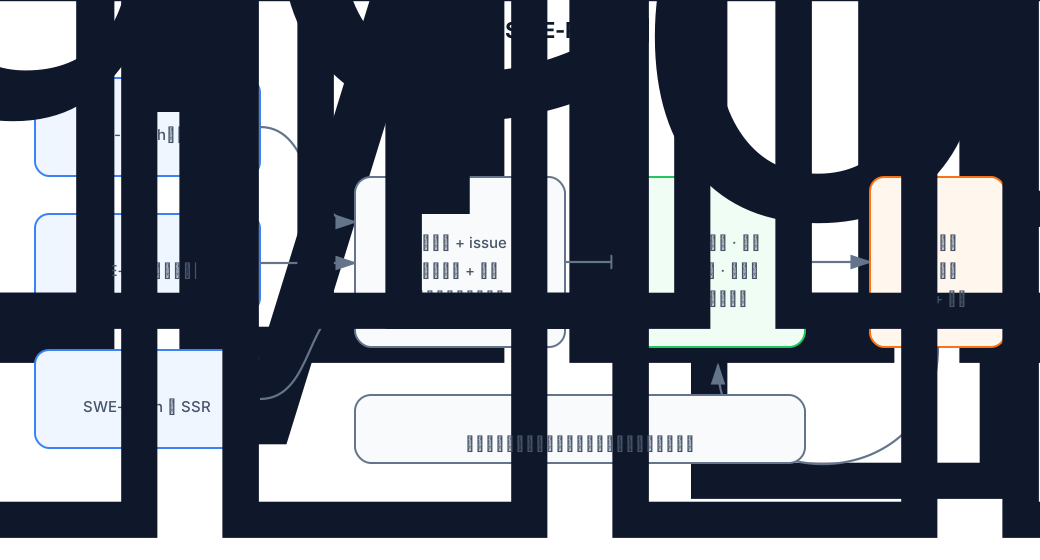
SWE-RL training requires a large number of (Issue, patch, tests) triplets. There are three sources:
Real PRs (SWE-bench Method)
PRs are scraped from GitHub, and the following are extracted:
- Issue text (the issue associated with the PR)
- Code diff (the changes made in the PR)
- Test cases (new or modified tests in the PR)
Scale: Approximately 2,300 entries (original SWE-bench)
Limitations:
- Limited data: 2,300 entries are insufficient for training large models
- Dependent on PR quality: Low-quality PRs are also collected
- Missing tests: Many PRs lack complete test coverage
Synthetic Data (SWE-smith Method)
SWE-smith (arXiv:2504.21798) — Intentionally inject bugs into good code and run tests to see which bugs are detected.
Scale: Over 50,000 entries (covering 128 Python repositories)
Advantages:
- Large volume: 20 times that of SWE-bench
- Controllable: Types and difficulty of bugs can be adjusted
- Complete testing: Each bug has corresponding test cases
Self-play SSR Method (Self-Generated Training Data)
Let the model:
- Find a "looks like a bug" place in the repository
- Write a "fix"
- Run tests to see if they pass
- The passed (issue, patch, test) triple as training data
This is the core idea of Section 20.3 SSR — the model generates its own training data.
Reward Function in SWE-RL
The reward function in SWE-RL is typically extremely simple:
def swe_reward(test_results):
    """Test results as reward"""
    passed = sum(test_results)
    total = len(test_results)
    return passed / total  # Or binary: 1.0 if passed == total else 0.0
This reward function is mathematically identical to the binary reward in R1-Zero — 0/1 binary reward.
Details of Reward Shaping
However, in industrial practice, several shaping terms are added:
Term 1: Test Pass Rate
reward = passed / totalNot binary, but a continuous value. This allows the model to receive partial reward when it "fixes half" of the issue.
Term 2: Length Penalty
reward -= 0.01 * len(trajectory)Encourages the model to complete the task in fewer steps — avoiding the waste of "first randomly change, then fix after test failure."
Term 3: Patch Quality
patch_quality = score_patch(model_output)  # Judged by LLM
reward += 0.1 * patch_quality
Encourages the model to generate more elegant patches (e.g., no code duplication, no breaking existing logic).
Term 4: Context Efficiency
context_efficiency = relevant_files_read / total_files_read
reward += 0.05 * context_efficiency
Encourages the model to read only relevant files, avoiding the waste of "reading all files."
However, Meta SWE-RL reported an important finding: the simplest reward (binary test pass) performs best. Complex shaping can easily introduce reward hacking — the model learns to "optimize shaping terms" rather than truly fixing bugs.
This aligns with the findings of R1-Zero: simple reward + large-scale RL > complex reward + small-scale RL.
Training Process of SWE-RL
A complete training process of SWE-RL:
┌─────────────────────────────────────────────────────────────┐
│ Step 1: Base model selection                                │
│   - Usually a code-tuned LLM (e.g., Qwen-Coder, DeepSeek-Coder) │
│   - Already pre-trained on a large amount of code           │
├─────────────────────────────────────────────────────────────┤
│ Step 2: Cold Start with SFT (Optional)                      │
│   - Use SWE-bench / SWE-smith data for SFT                  │
│   - Let the model learn the basic trajectory format         │
├─────────────────────────────────────────────────────────────┤
│ Step 3: RL Training                                         │
│   - GRPO / PPO                                              │
│   - Reward: Test pass binary                               │
│   - Long horizon: Each trajectory may have 16-100+ steps    │
├─────────────────────────────────────────────────────────────┤
│ Step 4: Rejection Sampling + Second SFT                    │
│   - Generate multiple candidates from the RL-trained model   │
│   - Select the best one for SFT                             │
├─────────────────────────────────────────────────────────────┤
│ Step 5: Evaluation                                          │
│   - SWE-bench Verified                                     │
│   - Internal evaluation set                                │
└─────────────────────────────────────────────────────────────┘
This process is highly similar to the training process of DeepSeek-R1 — both are combinations of SFT + RL + secondary SFT. The difference lies only in:
- R1's reward is based on whether the mathematical answer is correct.
- SWE-RL's reward is based on whether the test passes.
This similarity indicates: The training paradigm of RLVR is generalizable — as long as an appropriate verifier is found, the same algorithm can be applied to different domains.
Summary
SWE-bench is the core benchmark of SWE-RL, defining the task format of (issue, patch, tests). SWE is an ideal battlefield for RLVR — with clear answers, automated verification, and massive data.
SWE-RL differs fundamentally from traditional code generation — with long context, multi-file support, test feedback, and multi-step decision-making. This makes it highly aligned with Agentic RL, making it one of the most valuable applications of RL in industry.
Next, we will first examine Supplementary Reading: Meta SWE-RL to observe how GRPO and simple rewards are applied in real-world repositories, and then move on to 20.2 Code World Model and DeepSWE, addressing the issue of unstable training on long trajectories.