D.2 Probability, Expectation, and Random Estimation
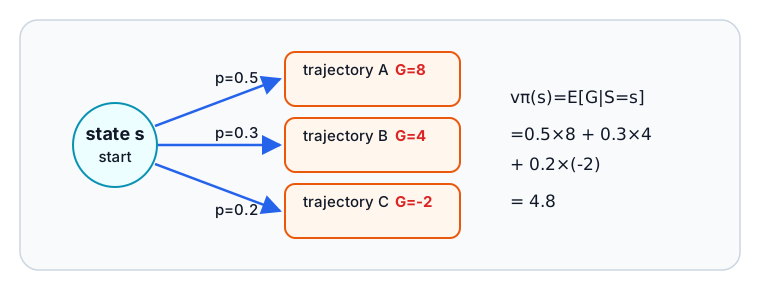
Data in reinforcement learning comes from random interaction: the policy may choose actions randomly, and the environment may return random feedback. To understand this randomness, we need probability theory. This section follows the natural order of probability: first sample spaces, events, and random variables; then probability, conditional probability, expectation, and variance; and finally Monte Carlo estimation, importance sampling, and the Bellman expectation equation.
Roadmap
| Article | Mathematical path | Role in reinforcement learning |
|---|---|---|
| D.2.1 Probability, Conditional Probability, and Expectation | sample space -> event -> random variable -> probability -> expectation | Describe stochastic policies and stochastic environments |
| D.2.2 Random Variables, Returns, and State Values | random return -> conditional expectation -> variance | Define value functions and the stability of learning signals |
| D.2.3 Variance, Monte Carlo, and Sample Averages | sample mean -> incremental average -> importance sampling | Estimate unknown expectations from data |
| D.2.4 Trajectory Probability, Baselines, and GAE | trajectory probability -> baseline invariance -> accumulated TD errors | Connect policy gradients with advantage estimation |
| D.2.5 Bellman Expectation Equation | take expectations over actions, rewards, and next states layer by layer | Derive the full Bellman expectation equation |
| D.2.6 Summary, Formulas, and Exercises | formula review -> common pitfalls -> exercises | Review and check understanding |